
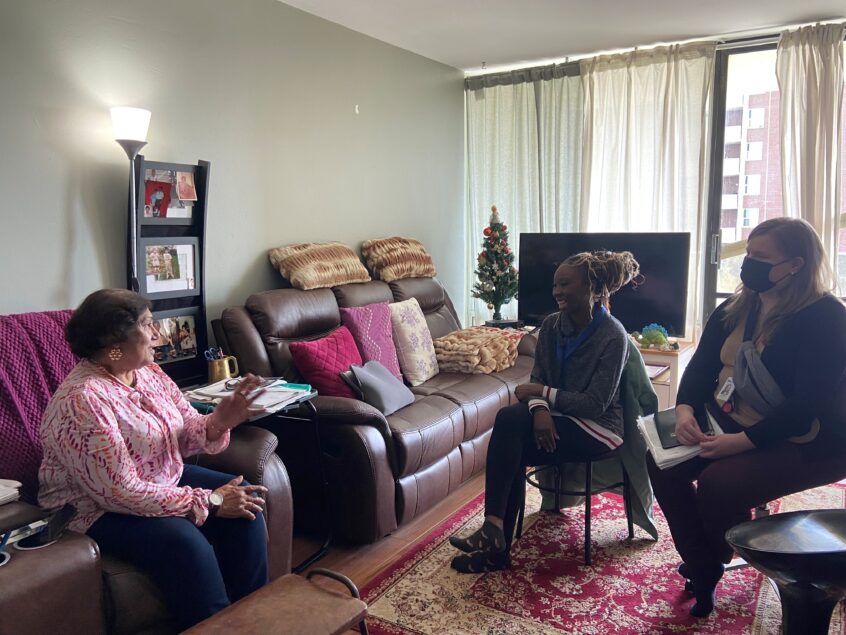
East Toronto residents living in the neighbourhoods of Taylor-Massey and Thorncliffe Park are receiving home care that benefits from a team approach thanks to the Integrated Neighbourhood Home Care Program provided by East Toronto Health Partners (ETHP) Ontario Health Team and its partners.
As the name suggests, the key to this program is integration – ensuring that clients are connected with the care they need, when they need it. Local healthcare and social services providers involved with this program work together as one team, sharing information and regularly communicating with clients in the program and with each other. The program is also supported by Ontario Health and Ontario Health atHome and funded by the Government of Ontario as part of the government’s plan to modernize home and community care in Ontario. The team approach in this program, which functions in a more integrated way than traditional home care, means that care can be adjusted more quickly as a client’s needs change. At the centre of this team approach are the program’s care coordinators like Subeer, Christine, Amy and Anjali.
“Being a care coordinator is a lot like being a case manager,” explains Subeer, ETHP Care Coordinator. “We’re setting up services, looking at referrals and taking on the intake role. We have long-term clients who require steady, continued support, but we also help clients who need more temporary support for things like wound care or a broken leg. Part of our role is to get clients into the program and then we work with service providers to start care services as quickly as possible.”
There’s a close working relationship between care coordinators and the home care specialists at VHA Home HealthCare (VHA) and Closing The Gap Healthcare, the teams who provide the in-home services to clients. The strong integration in the ETHP Integrated Neighbourhood Home Care Program allows homecare specialists to assess needs and quickly begin the additional services to support patient needs. They work collaboratively with care coordinators to achieve their common goal, to provide services in an efficient and timely manner.
Part of what makes such a high level of integration possible is the foundation of a community working for a community. “We’re a pretty tight-knit group,” says Christine, ETHP Care Coordinator. “With a small, dedicated team we’ve created strong relationships with each other, which I believe creates a better sense of accountability. When I’m coordinating additional services, I’m not calling a call centre. I call Ola, the Home Care Specialist responsible for that client and we work together to make it happen.”
Nowhere is the impact of the program more evident than among the service providers who have experienced the change firsthand. Among survey respondents, 80% of providers report being more able to meet patient needs, compared to typical home care. Survey results also showed an improvement in the experience of coordinated care. These surveys are part of a broader evaluation of integrated home care models, conducted through the Health System Performance Network (HSPN).
Working so closely with community service providers gives care coordinators better access to the information they need to succeed with coordinating and managing care. Community service providers are typically familiar with the specific services provided within the community and can make recommendations to the coordinators, enhancing the access to care.
“It’s about finding ways to say yes,” says Christine. “One client had a very important appointment at the hospital but was bedbound. We worked with ETHP partners to arrange the transportation needed to get her to that appointment.”
Anjali is one of the ETHP Care Coordinators supporting clients at Leaside Retirement Residence in Thorncliffe Park. Anjali noted that “close collaboration has facilitated strong communication among the Care Coordinator, community teams, and service providers. As a result, communication gaps are minimized, concerns are addressed more promptly, and collaboration to support clients is enhanced.”
“One of my clients who previously lived independently in the retirement home was experiencing a decline in health, visiting the emergency department almost every week,” Anjali added. “I looked at the client’s overall situation and worked closely with the Closing the Gap Home Care Specialist, increasing personal support service and nursing services to address client care needs. The entire process was well coordinated, allowing services to be arranged and implemented in a timely manner.”
Another Care Coordinator supporting clients at Leaside Retirement Home, Amy, said “Another positive aspect is that I can now devote more of my time to long-term care applications, as I rely on the Home Care Specialists to assist with complex decisions. This resulted in more than 10 clients being placed in the appropriate care setting over the last three months.”
Ultimately, more integration means better care. “The program is like a one-stop shop,” reports Ola, Home Care Specialist from VHA. “Integrated care means that when the need for additional services is recognized, calls can be made directly to the appropriate provider and sometimes people can get additional services as soon as the next day.”
Integrated care can also mean closer and faster access to primary care. “Many residents of these neighbourhoods have doctors who practice far away, and it’s harder for them to travel,” shares Subeer. “Through clinics like Health Access Taylor Massey, which is part of ETHP, we’ve gotten some frail seniors attached to nearby primary care very quickly, and residents have been able to see a physician the next day for assessment, referrals or whatever else they need.”
The needs of the client are the primary concern for every member of the care team. Integrated care does more than remove barriers. It helps bring together services, forms stronger bonds and creates a care environment where care coordinators can skillfully develop responsive and adaptable plans. Thanks to the dedication of coordinators like Subeer, Christine, Amy Anjali and their colleagues, along with community partners, residents are receiving streamlined care managed by an integrated care team with a direct connection to them and their community.